History of Hotel Ebersbach
A historic building in the heart of Široká Street, whose rear section forms part of the main city wall, has undergone an extensive renovation. Today it houses unique rooms and apartments where the past naturally blends with the present.
Historical Heritage
Medieval Roots and the Right to Brew
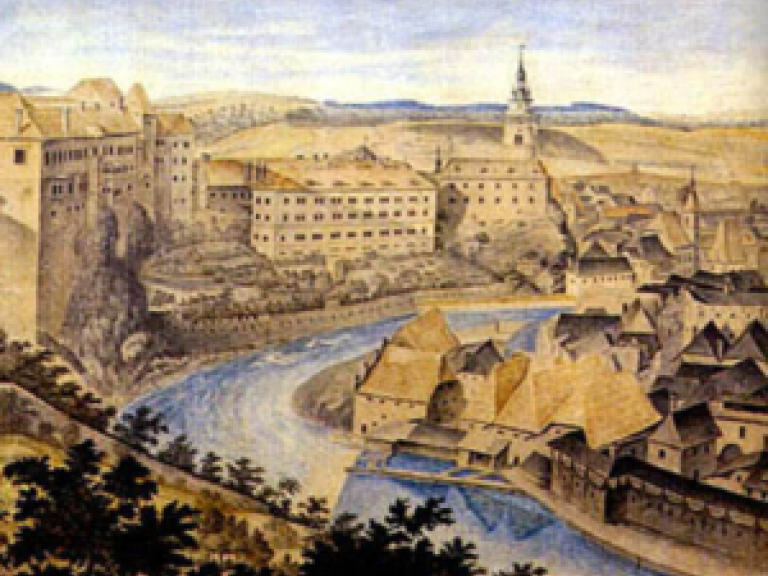
The history of the building begins deep in the 15th and 16th centuries. The first written records from 1523 mention the house as owned by a burgher named Šebestián. At that time, it consisted of two separate houses with rustic foundations. The house was highly valuable from the very beginning – it held the 'right to brew,' one of the most lucrative privileges, allowing the owner to brew and sell beer. This prosperity laid the foundations for a future grand reconstruction.
The Golden Age of Alchemist Ebersbach
The most significant chapter began in 1588, when both houses were purchased by the famous Antonín Michael of Ebersbach, personal alchemist to the ruler William of Rosenberg and chief administrator of the Rosenberg mines. Ebersbach was a man of high standing and immense wealth, which had to be reflected in his residence.
He embarked on a radical reconstruction that merged both houses. It is from this era that the unique arcaded courtyard, which today forms the heart of the hotel, originates, along with the magnificent Renaissance beam ceilings with rich painted decoration, which were uncovered during the recent reconstruction in the first-floor rooms. Ebersbach lived here in luxury, surrounded by flasks, old manuscripts, and the hope of finding Aurum potabile (Drinkable Gold) and the Elixir of Immortality for his lord.
His fall, however, was as swift as his rise. After the death of William of Rosenberg in 1592, Ebersbach was accused of fraud and sorcery. The new ruler, Peter Vok, had him imprisoned in the castle tower, where the alchemist died in 1593. The entire house was confiscated and became the property of the city.
The Era of Crafts, Colours, and Education
After Ebersbach's death, the house saw a succession of owners and functions. In 1628, the house briefly served as a German school, but the most distinctive mark was left by the craft era. In the 17th century, the house was bought by Řehoř Lanner, and subsequently, cloth makers and dyers settled here for many decades.
The most famous was the Fink family, who operated a dye workshop here throughout the 18th century. The modifications to the rear wings of the house, which served for drying fabrics and storing dyes, date from this period. Although the house underwent Baroque and Classicist alterations (as evidenced by some vaults on the ground floor), its Renaissance layout miraculously remained intact.
The Twentieth Century: Decline and Silent Waiting
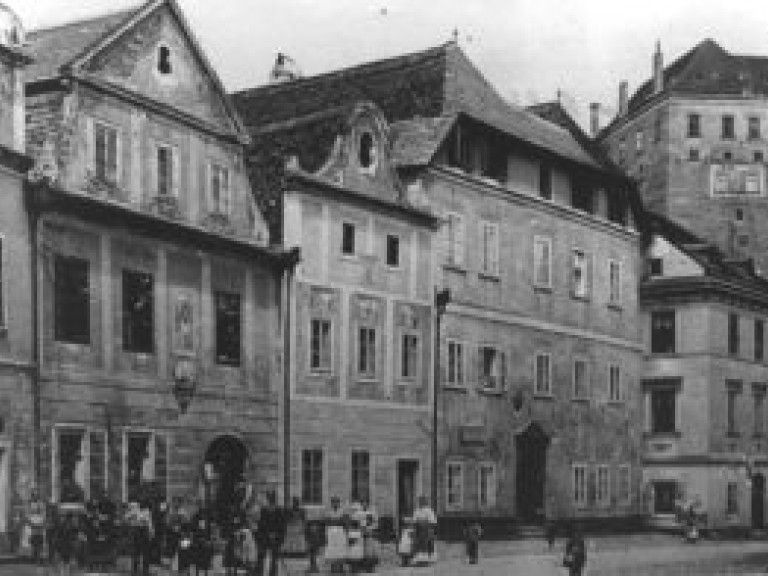
The first half of the 20th century was a period of stagnation for the house. Historical photographs from this era show the house in a rather austere state – it did not yet have its characteristic red facade. It served as ordinary housing, with warehouses and small businesses on the ground floor. After World War II and during the Communist era, the house gradually deteriorated, but thanks to its massive construction and the quality of Renaissance materials, it survived this neglect without fatal damage.
The Road to Hotel Ebersbach
A new era began in 2006, when new owners decided to restore the house to its former glory. An eight-year, extremely demanding reconstruction followed under the strict supervision of heritage conservators. The goal was not merely to 'repair' the house, but to literally restore it.
During the works, incredible discoveries were made:
- Original Renaissance paintings on wooden ceilings were uncovered and conserved.
- Restorers renovated stone window frames and historical vaults.
- The rear part of the house was transformed into a modern relaxation zone that organically connects with the historical substance.
In 2014, the house opened as Hotel Ebersbach. Today it is one of the few buildings in Krumlov where guests can stay in rooms that have preserved the authentic atmosphere of the 16th century, including a touch of mystery left behind by the famous alchemist.
Timeline
First written mention of the house. It was owned by Pavel Zbiják, a master cooper. After his death, the widow sold the house to maltster Jiří, known as Schon Greg. The house was sold to him with a brewing pan and other brewery equipment. The building had brewery facilities and the right to brew beer. The house was created by merging two neighbouring separate houses.
The building was owned by bookbinder Martin Gallus, who subsequently sold the house to butcher Jiří Rožďalovský.
The house was purchased by alchemist master Ebersbach from Jiří Roždalovský. Antonín Michael of Ebersbach was the mining administrator of William of Rosenberg. He devoted himself to alchemy, magic, and occult sciences. Master Ebersbach lavishly reconstructed the house during his period of prosperity. Master Ebersbach was tasked with producing a miraculous elixir of youth for his ruler. After the death of William of Rosenberg in 1592, Peter Vok of Rosenberg had the alchemist imprisoned beneath the castle tower. In 1593, Antonín Michael of Ebersbach died here.
Peter Vok of Rosenberg confiscated Ebersbach's house and donated it to his secretary, Mr. Martin Šurer of Waldheim.
Martin Šurer exchanged the house with Kryštof Albín of Helfenburk for house no. 4 on the square. Albín lived in the house with his large family.
The house was purchased by hatter Konrád Koller.
From this year, the house served as a German school.
During this period, the dyeing craft was practised in the house, passed down through generations. The first of the Fink family to live here was Tomáš, who dyed fabrics only in dark shades. From 1790 to 1806, dyer Ignác Miko lived in the house.
The house was acquired by cloth maker Antonín Riemer. His family lived in the house until the 1840s.
According to period photographs, the facade had not yet been painted in its distinctive red colour. To the left of the entrance portal, there was an asymmetric, presumably house sign on the facade. The house gradually deteriorated during the Communist regime.
Brought the first phase of the shingle roof reconstruction in 2005. The original project for the conversion of two buildings at Široká Street no. 77 and Hradební Street no. 172 into a hotel was developed between 2006 and 2010. In 2014, the demanding reconstruction of the house was completed with sensitivity and respect for its history.